
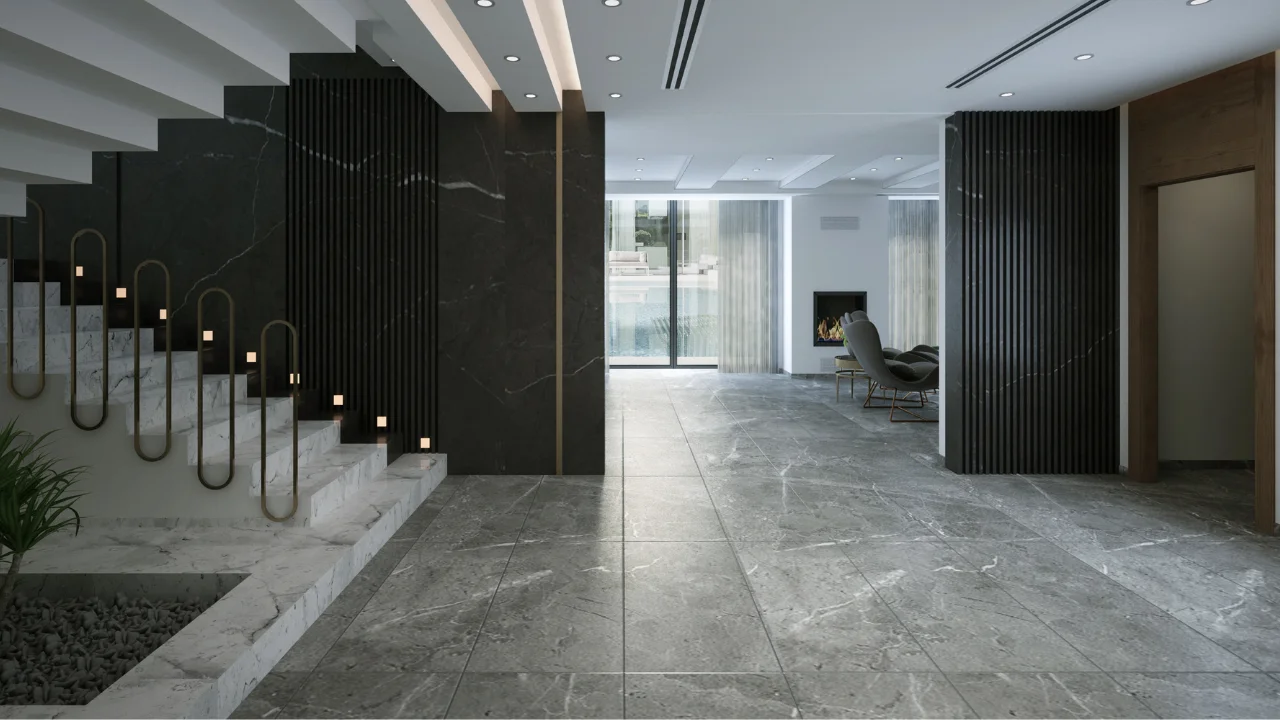
Floor tile has grown. Tiles measuring 24 by 24 inches, 12 by 24 inches and 24 by 48 inches are now common in bathrooms, entries and kitchens, and they are among the tiles we install most. A floor made of large tiles looks quieter and more open, and it has far fewer grout lines to scrub. The trade-off is that a big tile shows every flaw in the floor beneath it. Here is what to know before you pick one.
Why big tile needs a flatter floor
A small tile can follow a gentle dip in the floor and still sit flat to its neighbors. A large tile bridges across the dip. One end sits low, the other high, and the edge stands proud of the tile next to it. Industry guidance for large tile calls for a much flatter substrate than for small tile, and most older floors do not meet it as they stand.
That means preparation. A wood subfloor may need added stiffness and a leveling layer. A concrete slab may need grinding at high spots and a self-leveling compound in low ones. This work happens before any tile arrives, and it is the biggest single reason a large-format tile floor takes longer than a small-tile floor of the same size.
What goes into getting a floor ready is covered in subfloor preparation.
Lippage: the edge you can feel
Lippage is the height difference between the edges of two neighboring tiles. A little is normal in any tile floor. On large tiles it shows more, because light across a long, flat face picks out a raised edge, and bare feet and socks find it.
Large tile also has a little natural bow from the kiln, usually highest in the middle. Setters control lippage with a flat substrate, the right trowel and full mortar coverage, and leveling clips that hold neighboring edges level while the mortar sets.
Layout and the offset
Rectangular tiles are often laid in a staggered, brick-like pattern. With long tiles, a half offset puts the high middle of one tile next to the lower ends of the next, which makes lippage worse. Industry guidance for long tiles generally limits the offset to about a third of the tile length, unless the manufacturer says otherwise.
Layout also decides where the cut pieces land. With big tiles, a poor layout can leave a thin sliver along one wall or across a doorway. We plan the layout from the room's main sightline and doorways so the full tiles land where people look, and the cuts fall under cabinets, toilets and furniture.
Grout joints
Large tiles allow narrow grout joints, which is much of their appeal. Very thin joints need tiles with straight, square edges, often sold as rectified. Joint width still has to follow the tile manufacturer's minimum, and joints are not the place to hide a floor that is out of flat.
Choosing grout color and keeping it clean is covered in tile grout cleaning, sealing and regrouting.
What goes under the tile
Tile and grout are rigid, and wood subfloors move with the seasons. An uncoupling membrane between the subfloor and the tile lets the two move independently, which protects the tile and grout from cracking. Over concrete, the same kind of membrane helps bridge small shrinkage cracks in the slab.
If you want a warm floor, an electric heating mat goes in this layer too. Heated tile floors covers how that is planned.
Where large tile works best
- Mudrooms and entries, where porcelain handles salt, slush and grit through a Wisconsin winter, and fewer grout lines means less dirt trapped in joints.
- Bathroom floors, where a large tile makes a small room feel bigger. Shower floors are different: they need a slope to the drain, so they usually take smaller tile unless a linear drain lets the floor slope in one plane.
- Kitchens and open main floors, where a continuous stone or concrete look suits modern cabinetry.
Shower floors and drains are covered in tile shower waterproofing.
Handling and timing
A 24 by 48 inch porcelain tile is heavy and can crack if it is lifted wrong, so setters handle it carefully and often in pairs. Large tiles also need more mortar coverage on their backs than small ones, which means back-buttering each piece. None of that is visible in the finished floor, and all of it shows up if it is skipped.
Plan for the curing time too. Tile has to set before grouting and the grout has to cure before heavy use, and that time cannot be rushed.
Planning a large-format tile floor
Our tile and stone page covers the porcelain, ceramic and natural stone we install. Book a free in-home estimate and we will check how flat the floor is, plan the layout with you, and tell you what preparation the tile you like will need.